The Protocol Trap: Why Your 2026 RFP Selection Dictates Your Future Vendors
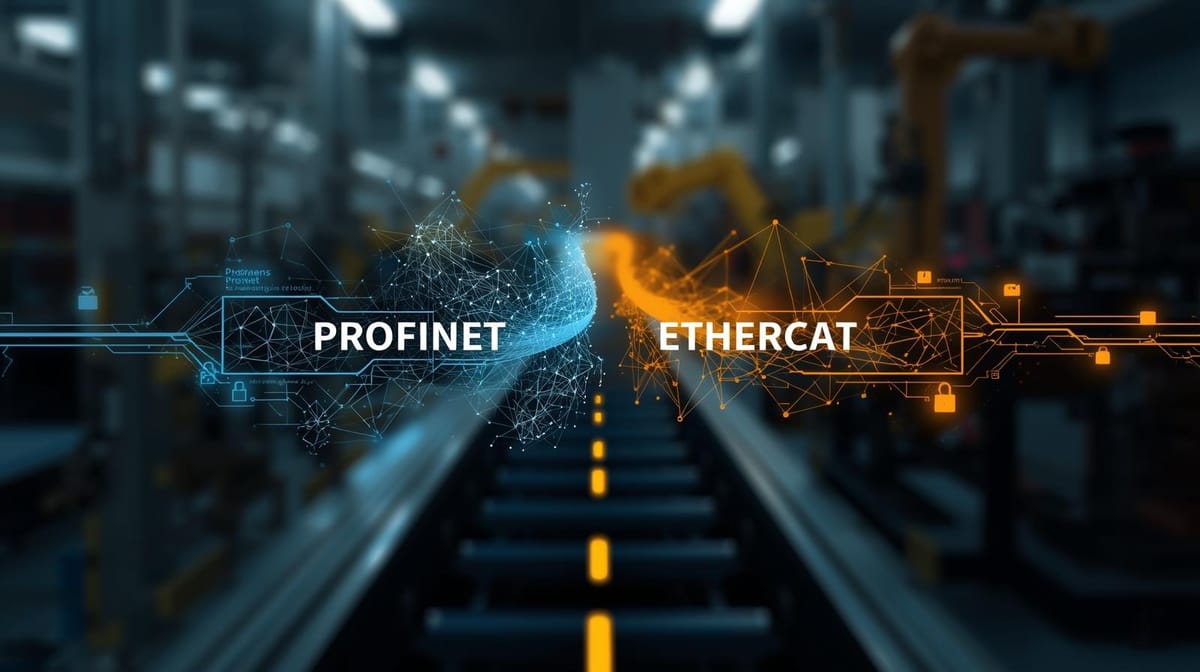
In the high-stakes world of industrial automation and material handling, a single technical choice in your Request for Proposal (RFP) can quietly strip away your future bargaining power. While procurement teams often focus on "steel and motors," the real leverage—and the real ROI—lies in the communication protocol.
By the time you realize your 2026 bid has locked you into a single-vendor ecosystem, the "rip and replace" cost is already too high to ignore. You haven't just bought a system; you've entered a Protocol Prison.
The Battle for Your Floor: Siemens (PROFINET) vs. The Open Market (EtherCAT)
Industrial Ethernet isn't a level playing field; it’s a battlefield of philosophies. Your choice between PROFINET and EtherCAT fundamentally changes who owns your facility's "nervous system."
- PROFINET (The Siemens Stronghold): Backed by the Siemens empire, PROFINET is the global heavyweight in discrete manufacturing. It is robust and reliable, but it often carries a hidden "Ecosystem Tax." Choosing PROFINET creates a gravitational pull toward Siemens PLCs, drives, and TIA Portal software. If you want to switch to a competitor's motor next year, the proprietary "safety" layers and integration friction make it a financial nightmare. You aren't just buying hardware; you're joining a club you can't leave.
- EtherCAT (The Neutral Rebel): Originally introduced by Beckhoff but now managed as a vendor-neutral open standard, EtherCAT is built for interoperability. It is a "functional" protocol rather than a "branded" one. You can run a high-performance ABB motor, a Beckhoff controller, and Omron I/O on the same line without the protocol "punishing" you for stepping outside one brand.
2026 Scorecard: AI Performance, Edge Compute, and Functional Safety
As Self-Executing AI moves to the edge, the "speed" of your network becomes a financial metric. If your protocol can't handle real-time autonomous decision-making, your AI is just expensive window dressing.
| Feature | PROFINET (IRT) | EtherCAT |
| Functional Safety | PROFIsafe: Integrated, but often creates vendor-specific dependencies that block third-party hardware. | FSoE (Safety over EtherCAT): Truly open; safety data travels across different hardware brands seamlessly. |
| AI/Compute Power | Good for bulk data, but cyclic overhead can lag behind real-time, autonomous decision-making logic. | Winner: "Processing on the fly" allows sub-millisecond AI reaction times on the edge. |
| Future Vendor Freedom | Low: You are essentially "married" to your primary hardware provider for the next decade. | High: Designed for a "mix-and-match" hardware strategy, giving you the leverage to switch. |
The Bottom Line for Your Next RFP
Legacy protocols like standard Ethernet are too slow for 2026's AI demands, and branded protocols like PROFINET can become a strategic bottleneck. If your vendor’s bid doesn't allow for multi-vendor Functional Safety (FSoE), you aren't buying an asset—you’re signing a long-term lease on your own floor.
Don't let a technical spec become a strategic mistake. Make sure your next Automation RFP demands interoperability as a core requirement to keep the vendors competing for your business, not the other way around.
Learn More:
EtherCAT vs PROFINET: Comparing the Leading Industrial Ethernet Protocols