NVIDIA Thor for Industrial Safety Systems: Why the Entire Thor Family Belongs in Your 2026 Automation RFP
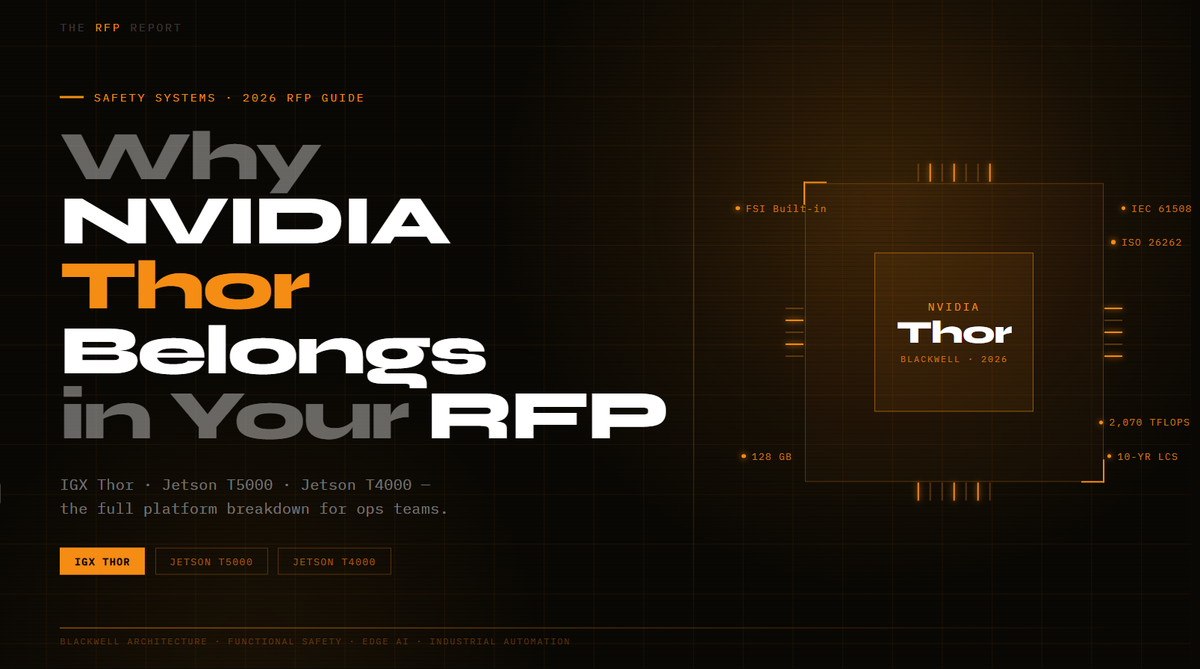
Learn how NVIDIA's Thor family — Jetson Thor (T5000), Jetson T4000, and IGX Thor — is redefining industrial safety systems and why procurement teams need to include it in their 2026 automation RFPs.
If you're writing or evaluating an automation RFP in 2026, there's a family of compute platforms you need to understand: the NVIDIA Thor series. It's not just a faster processor — it represents a fundamental shift in how industrial safety, AI reasoning, and real-time sensor processing can coexist on a single platform.
This post breaks down all three members of the Thor family, what each one does, and why your RFP requirements should explicitly reference them.
What Is the NVIDIA Thor Family?
NVIDIA's Thor family is built on the Blackwell GPU architecture and spans three distinct platforms, each targeting a different deployment context. Understanding which one applies to your environment is the first step to writing an RFP that doesn't accidentally exclude your best options.
1. NVIDIA Jetson AGX Thor (T5000)
Best for: Humanoid robotics, advanced AMRs, physical AI
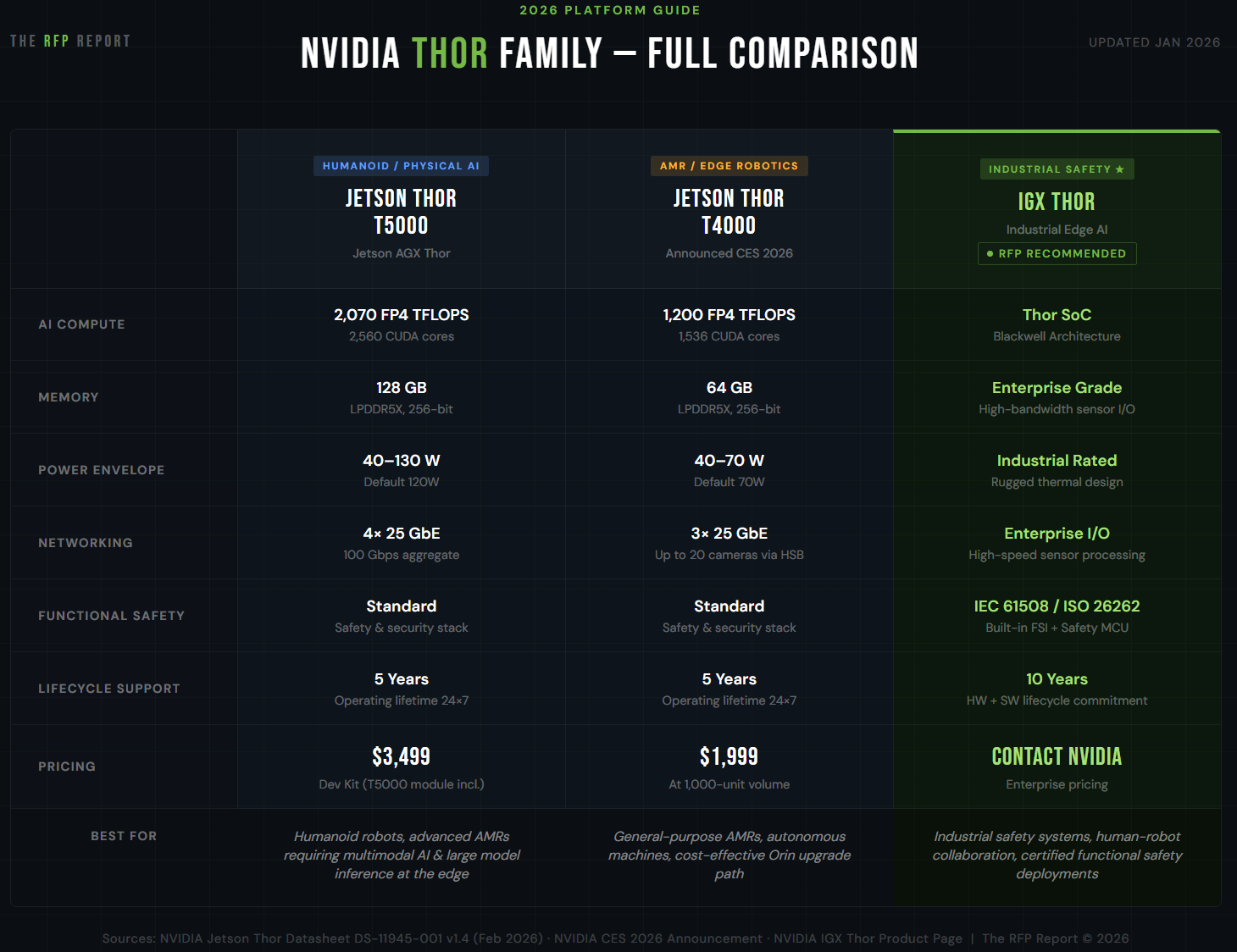
Jetson Thor is NVIDIA's most powerful Jetson module, designed for generalist robotics and physical AI. It delivers up to 2,070 FP4 teraflops of AI compute, powered by the Blackwell GPU with 2,560 CUDA cores and 128 GB of LPDDR5X memory — all within a 130 W power envelope.
Compared to its predecessor, Jetson AGX Orin, Jetson Thor offers 7.5x more AI compute and 3.5x greater energy efficiency, unlocking real-time reasoning and inference critical for highly performant physical AI applications. Early adopters include Amazon Robotics, Boston Dynamics, Caterpillar, and Figure — a strong signal that this platform is production-ready for demanding industrial environments.
The developer kit is available now at $3,499, with the T5000 module included.
For your RFP: If you're procuring AMRs or humanoid robots that will operate near people, ask vendors directly whether their platform runs on Jetson Thor or an equivalent Blackwell-based compute module. Require them to disclose the underlying compute platform in writing.
2. NVIDIA Jetson T4000
Best for: Cost-effective autonomous machines, general robotics, Orin upgrade path
The Jetson T4000 brings the Blackwell architecture to autonomous machines and general robotics at $1,999 at 1,000-unit volume, delivering 1,200 FP4 TFLOPS and 64 GB of memory within a configurable 70 W envelope.
This is the pragmatic choice for operations teams that need a meaningful performance jump from Orin-based systems without the full cost of Jetson Thor. It became generally available at CES in January 2026, making it a current-generation option you can specify today.
For your RFP: If you're upgrading an existing fleet or deploying general-purpose autonomous machines, the T4000 offers a credible, cost-justified upgrade path that vendors should be able to support. Ask for evidence of T4000 integration in their current product line — not just a roadmap commitment.
3. NVIDIA IGX Thor ⭐ The Safety-Critical Platform
Best for: Industrial edge AI, functional safety, human-robot collaboration
This is the platform that should get the most attention in your safety system RFPs. IGX Thor is a new class of enterprise edge computer built for industrial, robotics, and medical edge applications — and it's the only member of the Thor family purpose-built for certified functional safety.
Key specs and differentiators:
- Up to 5,581 FP4 TFLOPS of AI compute (iGPU + optional dGPU)
- 8x higher AI compute than its predecessor IGX Orin (iGPU)
- 2x better connectivity with 400 GbE
- Built-in Functional Safety Island (FSI) directly in the Thor SoC, alongside an on-board safety MCU
- Supports IEC 61508 and ISO 26262 — the standards your safety engineers already design against
- 10-year hardware and software lifecycle commitment from NVIDIA
Early adopters span industrial, rail, and aviation sectors. Hitachi Rail is deploying IGX Thor for predictive maintenance and autonomous inspection on live rail networks. Joby Aviation, Maven, and the SETI Institute have also committed to the platform.
The software stack matters as much as the hardware. IGX Thor runs NVIDIA AI Enterprise, which includes Isaac for robotics, Metropolis for visual AI, Holoscan for sensor processing, and — critically — NVIDIA Halos, NVIDIA's full-stack safety system that embeds functional safety directly into robotics and industrial AI systems.
For your RFP: Require vendors to provide evidence of IEC 61508 SIL 2 compliance or equivalent. Require documentation of the underlying compute platform running safety-critical workloads. A vendor running safety logic on a consumer-grade GPU is a compliance and reliability risk, regardless of how their proposal reads.
The Comparison at a Glance
What to Add to Your RFP Requirements
Traditional safety system RFPs ask vendors to describe their safety architecture. That's still necessary — but it's no longer sufficient. Here's what to add in 2026:
Require compute platform disclosure. Vendors must name the underlying compute platform running their safety logic. No exceptions.
Specify lifecycle requirements explicitly. Industrial deployments run 7–12 years. IGX Thor's 10-year hardware and software commitment is a concrete, verifiable requirement — not a vendor promise. Write it in.
Require functional safety certification documentation. Ask for evidence of IEC 61508 SIL 2 or ISO 26262 compliance from both the hardware and software layers.
Evaluate the software stack, not just the hardware. Vendors who have integrated NVIDIA Isaac, Metropolis, and Holoscan are further along the development curve than those building custom safety stacks from scratch. Ask for a software architecture diagram.
Name the project team and their platform experience. A vendor whose engineers have never deployed on a Blackwell-architecture platform will have a steeper learning curve — and your production environment shouldn't be their classroom.
The Bigger Picture
The Thor family represents a convergence that didn't exist two years ago: server-grade AI compute, certified functional safety hardware, and a 10-year industrial support commitment in a single edge platform.
For procurement teams, that convergence means you can now write RFP requirements that hold vendors to a genuinely higher standard — not just in raw performance, but in safety architecture, software maturity, and long-term supportability.
The vendors who are building on Thor know this. The vendors who aren't should have to explain why.
Tags: NVIDIA Thor, IGX Thor, Jetson Thor, Jetson T4000, Jetson T5000, industrial safety systems, automation RFP, functional safety, IEC 61508, ISO 26262, edge AI, AMR, AGV, warehouse automation, physical AI, Blackwell GPU, NVIDIA Halos, human-robot collaboration